Description
In 1990, IBM had its most profitable year ever. By 1993, the computer industry had changed so rapidly the company was on its way to losing $16 billion and IBM was on a watch list for extinction -- victimized by its own lumbering size, an insular corporate culture, and the PC era IBM had itself helped invent.
Then Lou Gerstner was brought in to run IBM. Almost everyone watching the rapid demise of this American icon presumed Gerstner had joined IBM to preside over its continued dissolution into a confederation of autonomous business units. This strategy, well underway when he arrived, would have effectively eliminated the corporation that had invented many of the industry's most important technologies.
Instead, Gerstner took hold of the company and demanded the managers work together to re-establish IBM's mission as a customer-focused provider of computing solutions. Moving ahead of his critics, Gerstner made the hold decision to keep the company together, slash prices on his core product to keep the company competitive, and almost defiantly announced, "The last thing IBM needs right now is a vision."
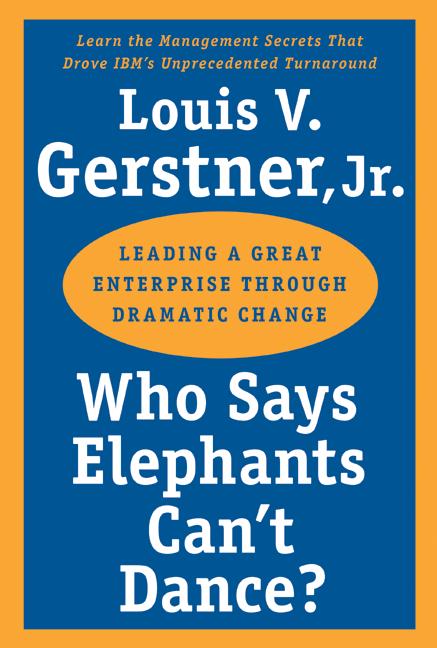
Who Says Elephants Can't Dance? tells the story of IBM's competitive and cultural transformation. In his own words, Gerstner offers a blow-by-blow account of his arrival at the company and his campaign to rebuild the leadership team and give the workforce a renewed sense of purpose. In the process, Gerstner defined a strategy for the computing giant and remade the ossified culture bred by the company's own success.
The first-hand story of an extraordinary turnaround, a unique case study in managing a crisis, and a thoughtful reflection on the computer industry and the principles of leadership, Who Says Elephants Can't Dance? sums up Lou Gerstner's historic business achievement. Taking readers deep into the world of IBM's CEO, Gerstner recounts the high-level meetings and explains the pressure-filled, no-turning-back decisions that had to be made. He also offers his hard-won conclusions about the essence of what makes a great company run.
In the history of modern business, many companies have gone from being industry leaders to the verge of extinction. Through the heroic efforts of a new management team, some of those companies have even succeeded in resuscitating themselves and living on in the shadow of their former stature. But only one company has been at the pinnacle of an industry, fallen to near collapse, and then, beyond anyone's expectations, returned to set the agenda. That company is IBM.
Lou Gerstener, Jr., served as chairman and chief executive officer of IBM from April 1993 to March 2002, when he retired as CEO. He remained chairman of the board through the end of 2002. Before joining IBM, Mr. Gerstner served for four years as chairman and CEO of RJR Nabisco, Inc. This was preceded by an eleven-year career at the American Express Company, where he was president of the parent company and chairman and CEO of its largest subsidiary. Prior to that, Mr. Gerstner was a director of the management consulting firm of McKinsey & Co., Inc. He received a bachelor's degree in engineering from Dartmouth College and an MBA from Harvard Business School.
On April 1, 1993, Louis V. Gerstner, Jr. began his remarkable career at IBM as Chairman of the Board and Chief Executive Officer. It was a job that had been repeatedly passed up by the top CEO titans in America-Jack Welch of General Electric, Larry Bossidy of Allied Signal, George Fisher of Motorola, Bill Gates of Microsoft-and had initially even been rejected by Gerstner himself when he was the first candidate offered the momentous opportunity in December 1992. Although viewed by the general public as a national treasure, at that time in the American corporate landscape IBM was unanimously considered a plodding dinosaur in the technology industry, with sales and profits declining at a steadily alarming rate. Lacking vision and clinging to their mainframe mentality, they missed out on the first wave of the personal computer revolution. Transforming the financial ledger from the red to the black for a company of such size and magnitude as the iconic IBM was considered a suicide mission that even the savviest CEO was afraid to undertake. But, as Gerstner bluntly explains in his book Who Says Elephants Can’t Dance?: Leading a Great Enterprise Through Dramatic Change, “I have always been drawn to a challenge.”
In the surprisingly candid Who Says Elephants Can’t Dance? Louis V. Gerstner, Jr. escorts students through one of the greatest turnarounds in history as he recounts how he brought IBM back from the brink of corporate insolvency to lead the computer business once again, just like in its earlier halcyon days of the 1960s and 1970s. Offering a unique case study drawn from decades of experience at some of America’s top companies, such as McKinsey, American Express, and RJR Nabisco, Gerstner’s penetrating insights into management and leadership are applicable to any business, at any level, and will help your business students understand which dynamics make a company achieve greatness from top to bottom. Ranging from strategy to public relations, from finance to organization, Gerstner reveals the hard-won life lessons of running highly successful and competitive companies.You may also like
Top Trending