



Description
By: Pedro Ignacio Alonso, Paulina Bitran
An ingenious reconstruction—and revealing analysis through “visual archaeology”—of avant-garde artist Kazimir Malevich's lost arkhitektons.
Among the Russian avant-garde artist Kazimir Malevich’s most intriguing works, the arkhitektons are also the most enigmatic, as these quasi-architectural sculptures made in the 1920s were almost entirely lost, along with many of the accompanying drawings, or planits. In The Additional Element in Architecture, Pedro Ignacio Alonso and Paulina Bitrán bring Malevich's elusive arkhitektons to startling, three-dimensional life and show how these objects form a comprehensive universe that embodies the artist's Suprematism—his belief in the supremacy of pure artistic sensation in abstraction.
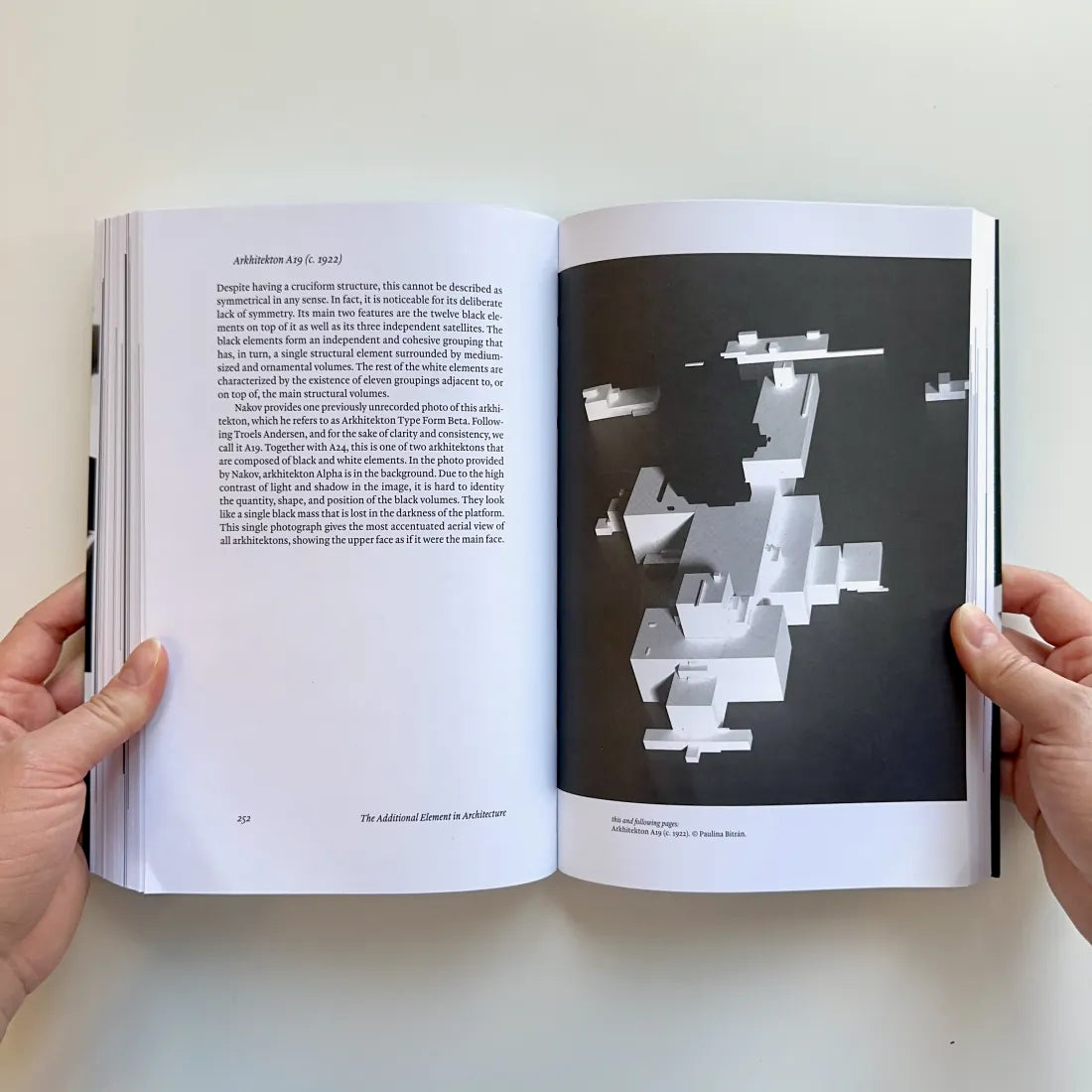
The book features digital reconstructions of 15 arkhitektons and planits that are lost in their original physical form. Using a method they call visual archaeology, Alonso and Bitrán explore how these structures figure in Malevich's investigations of spatial form. In the authors’ view, the arkhitektons and planits constitute a series of changing configurations, or “states,” rather than fixed or closed monolithic sculptures that can be reckoned with individually. They are provisional assemblages of prismatic volumes linked only by gravity and equilibrium—ephemeral arrangements that digital modeling exposes and opens to new analysis.
Along with its illustrations and analysis of the ingeniously recreated arkhitektons and planits, Alonso and Bitrán provide historiographical notes on the different appearances of these models, as well as a critical consideration of how Malevich’s own conception of the “additional element” might place these beguiling figures within a wider history of modern architecture.
An ingenious reconstruction—and revealing analysis through “visual archaeology”—of avant-garde artist Kazimir Malevich's lost arkhitektons.
Among the Russian avant-garde artist Kazimir Malevich’s most intriguing works, the arkhitektons are also the most enigmatic, as these quasi-architectural sculptures made in the 1920s were almost entirely lost, along with many of the accompanying drawings, or planits. In The Additional Element in Architecture, Pedro Ignacio Alonso and Paulina Bitrán bring Malevich's elusive arkhitektons to startling, three-dimensional life and show how these objects form a comprehensive universe that embodies the artist's Suprematism—his belief in the supremacy of pure artistic sensation in abstraction.
The book features digital reconstructions of 15 arkhitektons and planits that are lost in their original physical form. Using a method they call visual archaeology, Alonso and Bitrán explore how these structures figure in Malevich's investigations of spatial form. In the authors’ view, the arkhitektons and planits constitute a series of changing configurations, or “states,” rather than fixed or closed monolithic sculptures that can be reckoned with individually. They are provisional assemblages of prismatic volumes linked only by gravity and equilibrium—ephemeral arrangements that digital modeling exposes and opens to new analysis.
Along with its illustrations and analysis of the ingeniously recreated arkhitektons and planits, Alonso and Bitrán provide historiographical notes on the different appearances of these models, as well as a critical consideration of how Malevich’s own conception of the “additional element” might place these beguiling figures within a wider history of modern architecture.